ERRORS in rigging can pose several challenges from reducing catch rates to costing you that fish of a lifetime. Almost every time I have taken a short cut or deviate from tried and tested methods, the penalty and some type of failure eventually follows. Mistakes provide a great opportunity to learn and refine your technique but rather than make your own, a few common mistakes and learnings are noted below.
TEST AND INSPECT KNOTS
Every knot that you tie introduces a potential point of weakness in your rigging. Creating twists, crossing over and distorting lines will naturally weaken it so the notion that a knot can retain 100 per cent of the lines breaking strain does not make sense so it pays to check and test every know that you tie. The key to testing a freshly tied knot is to exert constant and forceful pressure without being too overzealous on lighter lines. On heavier tackle you should try to pull as hard as possible. A good knot will be neat, snug and appear uniform. If it feels secure but does not look good, then you should retie it. Always get into the habit of lubricating knots with a little saliva before pulling too tight to help the knot snug the down tightly. Just remember that a curly tag and a missing hook or lure indicates a poorly tied knot that has unravelled!
Complacency in presentation Certain species teach you valuable lessons and for me, the early days of soft plastic lure fishing for bream almost two decades ago taught me plenty. If my lure was not perfectly straight it would spiral on the drop and lurch unnaturally when twitched. An imperfect presentation reduced strike rates by well over half and would result in wily bream ignoring my lure with an increased amount of bycatch like flathead and tailer that were not anywhere near as fussy. I tested that theory a few times when the bream were around and it almost always held true; if my lure was not dead straight and I did not bother correcting it, the fishing slowed right down immediately. Once fixed so the lure tracked straight, and the bream returned. Similar observations have been made fishing alongside other anglers; those in the know take the time to rig baits with the most natural presentation possible, minimising the chances of the bait spinning artificially in any current and ensuring hook points are exposed in the correct orientation to optimise hooking up.

Scott ThomasEdit Profile
IGNORING NICKS OR FRAYED LINE
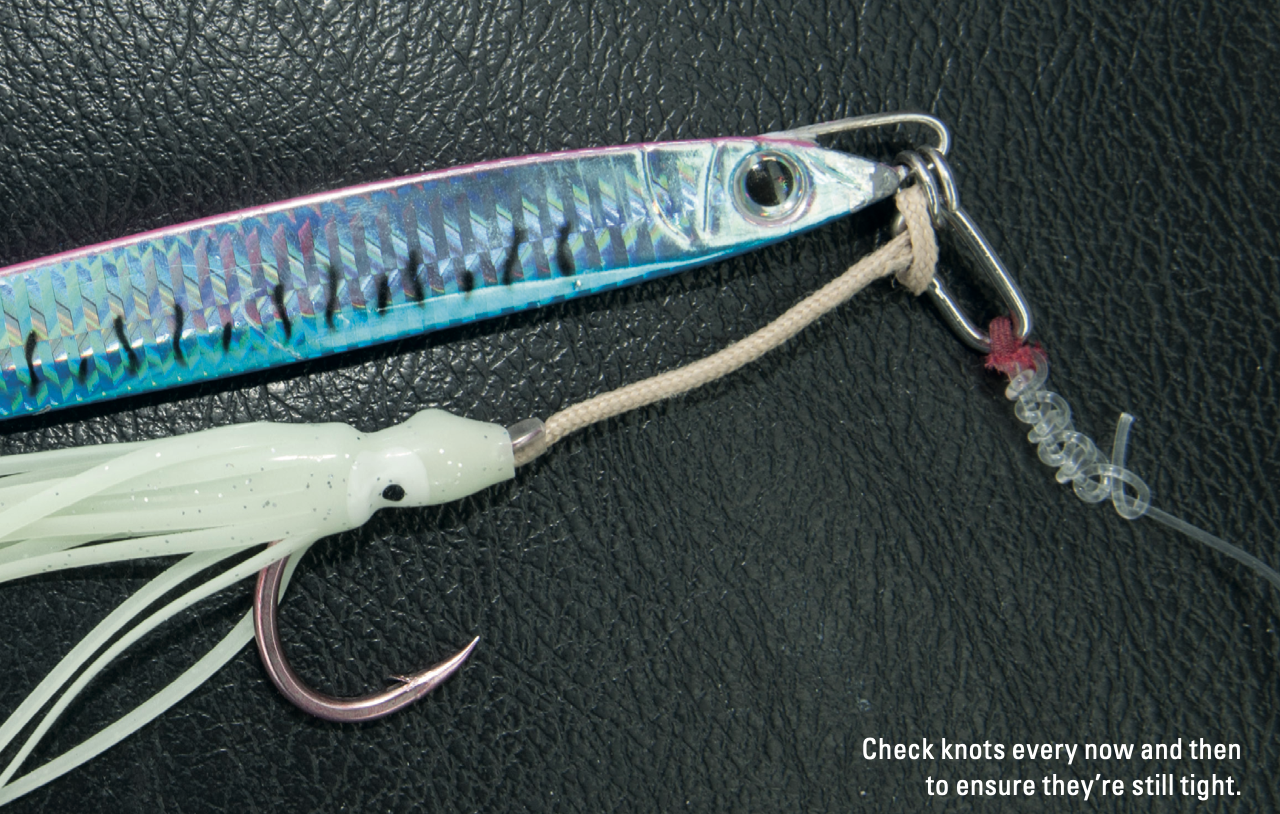
The costliest mistakes I have made in my rigging have almost always related to failing to check my rig after freeing it from a snag or after catching a fish. Abrasion from any underwater obstruction will invariably damage your line. A frayed leader might seem strong on the face of it but once the leader shell is compromised, the breaking strain diminishes rapidly. Fish with sharp teeth could neatly slash leaders which might appear benign with a cursory glance but is a disaster waiting to happen. Even if they do not have sharp teeth, a fish can bite down on a knot and this compressive force against a jig head, lure bib or hook eye can crush and compromise your leader without too many visual cues. After every fish or snag you should always run your fingers over the leader, visually inspect your rig and test any knots.
FISHING TOO HEAVY
You should always use the lightest possible sinker, jig head or weight required to cast or get your rig to the bottom. Fish do not have hands; they inhale a bait or lure by flaring their gills to draw water and anything in proximity into their mouths. If they weight is too heavy, the fish will struggle to move the bait or lure and if they do happen to get it in their mouth, the unnatural pressure and resistance created by the heavier weight will cause them to quickly eject your offering and flee the scene. Similarly, lines and leaders that are too heavy will have great surface areas creating increased drag and making it more difficult for your bait or lure to reach bottom in deeper water or heavy current. Heavier lines and leaders are more visible and stiffer, further impeding your rig by appearing unnatural and stifling the action of a well-presented bait or lure.
INAPPROPRIATE HOOKS AND CONDITION
Mistakes in choosing the most appropriate hook are either due to the size of the hook, strength of hook or not paying attention to hook condition. Hooks that are too Large in gape or too heavy in wire will not only look unnatural but will diminish the action of a bait or lure. Hooks that are too small on the other hand may not allow enough point exposure for a decent hook-up or can easily straighten if fished on heavier lines. Reusing old hooks is a classic gotcha and once exposed to the elements, especially salt water, hook points and wire start degrading. It might be tempting to throw your old hooks back in with the others at the end of a trip but just remember that a rusty hook which is not isolated can quickly taint a new batch of hooks causing them to corrode prematurely. As with knots, it pays to check your hooks after every fish to check that the hook point has not snapped, rolled over or otherwise become blunt. A sharp hook should catch on your fingernail and not drag; that “stickiness” of a sharp hook will dramatically improve your catch rates!