
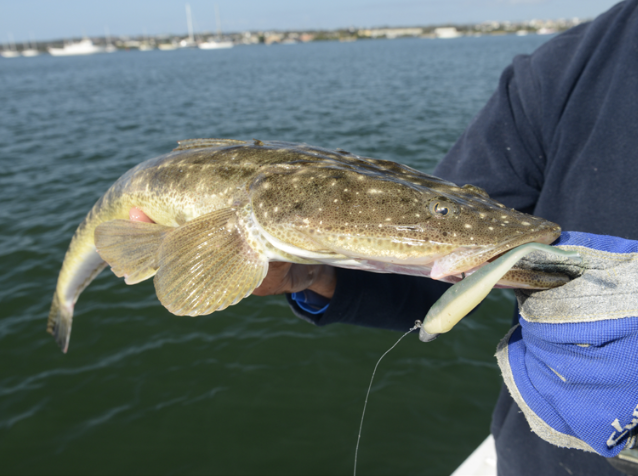
OVER many years of fishing, I must say that the humble flathead is an all-time favourite species. Flathead have a striking and intriguing appearance are one of the most reliable species for anglers of all levels to pursue. Whilst not known for their fighting prowess, a large flathead is quite a formidable adversary on light tackle.
The fight of a big flathead is unpredictable and erratic that can catch anglers unaware, often resulting in broken leaders and stories of the one that got away. Flathead reside on the bottom and prefer sandy or muddy habitats interspersed with weed or rock. They can be targeted in rivers, estuaries and beaches whilst also appearing in large aggregations out to sea. Baits and lures both work exceptionally well with the added advantage of the humble flatty not too fussy when scouting out a meal.
Being a relatively aggressive and opportunistic ambush predator with a large mouth allows them to be targeted by a wide variety of rigs and offerings across several different saltwater environments.
OFFSHORE FLATHEAD RIGS
Targeting sand or tiger flathead offshore is a relatively straightforward affair once you find a schooling aggregation. Finding those aggregations is often a case of trying various depth ranges till to happen upon a school. A simple paternoster rig is a straightforward and relatively successful way of targeting flathead offshore. A twin hook rig baited with strips of mullet or cubes of fresh pilchards is ideal with suicide hook sizes of 2/0 or 3/0 most suitable or if fishing circle hooks, a slightly larger 4/0 sized circle is a good allrounder.
Offshore flathead fishing is not what you would call a finesse activity however it still pays to use the lightest weight possible to keep your baits on the bottom. The size of the braid and outfit will be dictated by the weights required. I typically use a lighter outfit with 10lb braid and a 3000 sized reel for weights up to two ounces and 15lb braid on a 4000 sized reel for anything heavier. Drifting and covering ground is vital however once you find the fish you want to slow the drift down so a sea anchor or electrical motor are quite useful to keep you in the strike zone.
ESTUARY AND INLAND FLATHEAD RIGS
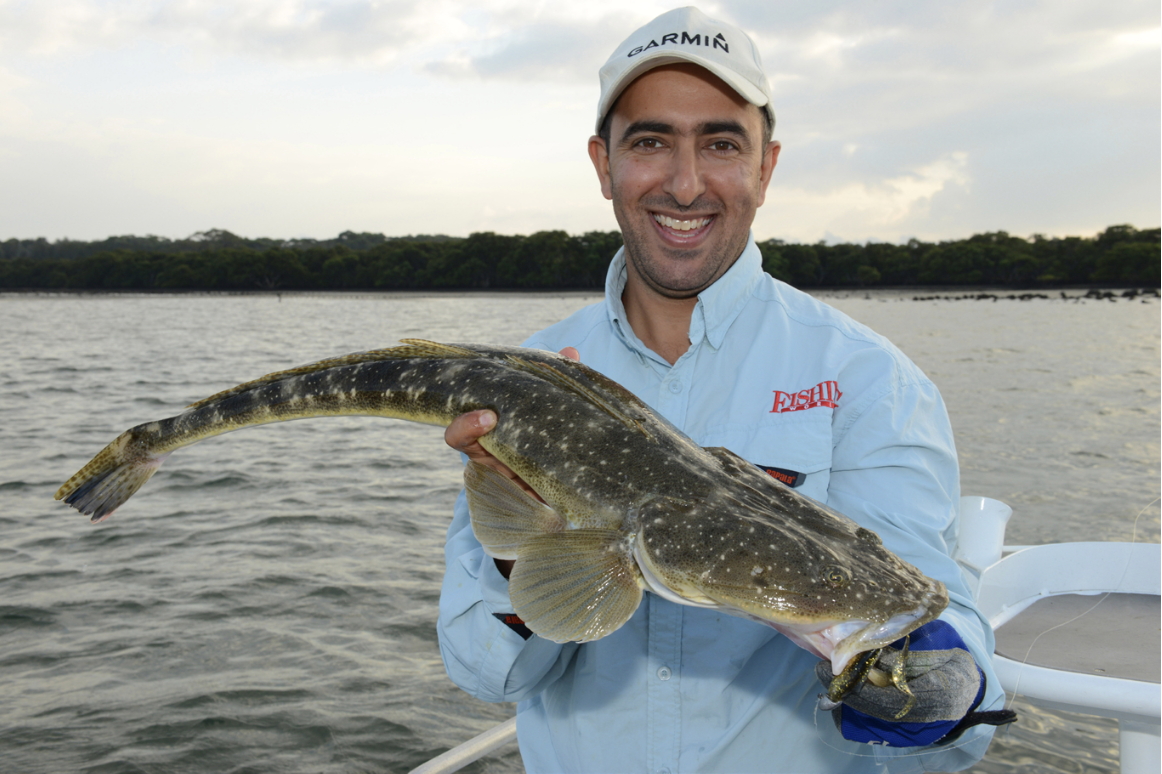
Flathead are most commonly encountered in lakes, rivers and estuarine waters. An eight to ten foot rod coupled with six kilo line and a matching reel is a perfect all-round outfit to cast out a few baits in search of a flathead from the shoreline. As with most species found within inland saltwater regions, a light running ball sinker rig is simple and often the best. Flathead have relatively large mouths so hook sizes from 2/0 to a 4/0 suit well and ideally the size used should matched the bait.
In the estuaries, flathead will often sit on the bottom and cover themselves with sand, awaiting an easy meal to swim within striking distance. With this in mind, one of the best ways to fish your bit is by casting it out and slowing retrieving it back, fanning out subsequent casts to cover more ground and track down where the flathead are lurking. Another deadly rig shown to me by an old mate involves the use of three ganged hooks with a trailing double; the ganged hooks are thread onto a whole pilchard like normal with the double hook pinned through each section of the tail fin.
The rig is fished without any extra weight and is cast out then allowed to sink to the bottom retrieved slowly through patches of weed adjacent to sand. I love chasing flathead on lures and for this application a light single handed casting outfit loaded with eight-pound braid is a good allrounder. Four-inch soft plastic paddle tail and curl tail style lures in white or with hints of black, gold, or red are lures of choice. Most of my soft plastic lure fishing is in less than seven metres of water without any significant current so a 1/4oz, 2/0 jig head is a great starting point. An abrasion resistant and hard fluorocarbon leader of 15lb breaking strain rounds out the outfit nicely.
ESTUARY FLATHEAD ON SURFACE LURES
Whilst not a topwater species in the true sense of the word, shallow sand flats can offer some explosive visual fishing as large flathead cause all manner of commotion when attacking a lure in the shallows. As the tide starts to run, flathead will often follow the flow of water and in turn the flow of baitfish and crustaceans into the flooding shallows where the bait desperately seek respite adjacent to tree roots, rocky shorelines or shallow patches of weed.
A light single-handed rod loaded with six or eight pound braid and capable of casting 70-120mm top water pencil lures is ideal. Another alternative is to use hard bodied swimbaits and large six or nine inch soft plastic stick baits with a treble stinger hook which can be cast on slightly heavier spin tackle or for an added thrill and challenge can be used with bait cast tackle.
Don’t be afraid to cast into water that is only a few inches deep; flathead need very little water to cover their bodies and can often be found up in the shallows sunning themselves and awaiting an unsuspecting prawn or baitfish to dart by. A shallow water flathead in attack mode will rise to attention, seemingly crouching on their pectoral fins and springing to life with an explosive turn of speed to attack a lure in the shallows. Anyone that thinks flathead are a mundane species clearly hasn’t encountered a croc sized model trying desperately to inhale a well-presented lure off the surface!