
I SPEND a lot of time trolling the water off the Gold Coast using a wide variety of skirted trolling lures. Most of the time we are targeting marlin, either black marlin on the inshore grounds, or bigger blue marlin out on the edge of the continental shelf. Skirted trolling lures have a long history, first being used behind kayaks and canoes in the Pacific Islands. A lot of these lures were made from the pith of a banana tree.
A lot more advanced designs were later made in Hawaii using resins and plastic skirts. Jo Yee was one famous Hawaiian lure maker, and original Jo Yee designs are now worth hundreds of dollars to collectors.
The principal design features of a skirted trolling lure are as follows. Firstly, the lure has a trolling head to which the skirts are attached. This head may be shaped in different ways, and all these shapes affect the action of the lure in the water.
Large, cupped faces create turbulence and resistance when pulled through the water, increasing drag and increasing the bubbles from this turbulence. Narrow jet head designs are less affected by water pressure and have less inherent action. Sliced head lures generate side to side action. Some skirted lures are weighted with inserts and most have eyes inserted into the head.
There is a central hole through the middle of all skirted lures where they thread onto the leader. A lot of lure designs incorporate many of the above features into a single head.
To the back of the lure head, usually attached by glue onto a slot at the rear of the head, lure skirts are attached. These are usually plastic squid style skirts, and they are available in a myriad of colours. The wobbling action of the lure head, when dragged through the water, imparts action into the lure skirt, and when viewed from underwater the lure looks extremely life like as it is dragged behind the boat.
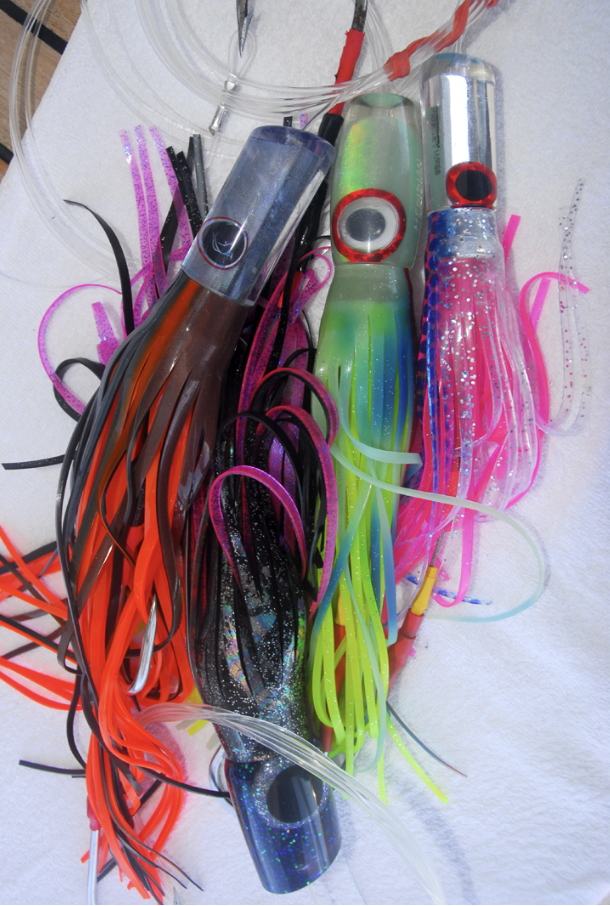
This is why skirted lures are such effective fish producers. The other advantage of the skirt is that it covers the hooks, and these lures are well capable of carrying serious hooks for big fish.
The above is a simple overview of how a skirted trolling lure is designed, and once you understand that you can work out how to effectively troll these lures. In general, I troll for most pelagic species between 6 and 8 knots.
At this speed the lure’s head action kicks in and you can see it working away in your lure spread, intermittently diving down showering bubbles behind it before returning to the surface. Some subtle “Tube” designs hold the bubbles for a period alongside the lure head, creating a very effective illusion.
Because we are generally targeting billfish heavy leader is required in all our skirted lures. This can reduce the action of the lure and it is always a compromise between lure action and leader size. Hooks are rigged at the end of the leader, and in the last few years I’ve gone back to a single hook rigged well back in the skirt.
This hook is rigged on a short length of wire cable that is attached to the mono leader. These hooks are all “J” hook patterns and vary according to the size of the tackle being used.
Lure selection is based on sea conditions, what baitfish are around and what type of marlin are being targeted. In rough conditions it is important to have lures that will hold in on a rough sea rather than bouncing around, and weighted heads and cupped faced lures have a distinct advantage when seas are up.
In calm conditions lighter heads, tubes and smaller cupped faced pushers work well on the lines closest to the boat and sliced headed patterns and straight running jet heads work well on the outriggers and from the shotgun position, which is the lure positioned the furthest back from the boat. As the rods in these positions are generally run from outriggers or a rocket launcher, the line is lifted out of the water which decreases the resistance, lifts the lure up in the water column and increases its action.
Skirted trolling lures catch a wide range of fish species and are effective in a wide range of scenarios. On the inshore grounds downsizing the lures is a great way to target tuna, spotted and Spanish mackerel. When mackerel are the target, I rig my skirts on wire. Wahoo are another favourite
species and like their lures trolled at high speed. Using specific heavy metal headed lures called Hex Heads designed for wahoo, we can troll at up to around 18 knots. At this speed the strikes are sensational! When we are targeting black marlin on the inshore grounds, we also catch dolphin fish, mackerel, striped and yellowfin tuna and wahoo. This gives us plenty of fillets to take home.
If you are just setting up your boat for trolling and need advice as to what lures to use, spend some time online and visit your local tackle shop. These lures tend to be expensive, and it is easy to spend hundreds of dollars quickly if you get in a mad flurry of shopping excitement.
Cheaper brands often catch fish just as well as the more expensive designer lures. The most important thing is to rig your lures correctly. Lure selection gets a lot easier once you’ve had time on the water. A lure that gets multiple strikes stays in the lure spread, a lure that misses out when other lures get hit gets dumped after three trips! You will soon find your favourite colours related to your success, but white, lumo green, purple and pink, silver and blue and purple are all good colours.
Skirted trolling lures are great toys to play with at home when it is too rough to fish. There’s a constant need to re-rig, re-hook and re- leader after successful trips. Trolling skirted lures is a great way to fish and there is always something to experiment with.