
If it’s possible, I always try to dedicate time before I fish to finding the fish. It’s not always easy to do because I love fishing, but It’s worthwhile. I know that sounds like ”Idiot Rule no: 1”, but I don’t see that’s it’s happening as much as it should be. With time spent on the water, devoted to locating good structure, bait or the target species themselves, catch rates will improve.
Modern electronics, if you have a level of skill, makes for productive sub-surface investigation, but so too does good old-fashioned observation. Baitfish often ripple the surface and birds feed on bait. In estuaries, steep rocky banks and rock walls are indicative of rock-strewn bottoms that can hold bait and predators, whilst points can cause eddies on certain tides. The outer bank on a riverbend is usually deeper than the inner bend whilst pylons of any type are always worth investigating. Water temperature is another factor to take into consideration. Finding warmer offshore water might mean you’ll find pelagic species such as mackerel and billfish, whilst patches of warmer water are go-to areas when chasing barra in dams.
Finding fish in the washes of ocean rocks is nigh impossible without jumping in for a look. When I’m exploring a new area, I put on the goggles and checkout likely gutters and bombies, prior to returning to fish. Obviously, the prime goal is to spot fish such as drummer, bream and luderick, but in the case of a potential mulloway spot (large and small), caves and narrow gutters are key.
The “Hole of a Thousand Jews”, is the perfect case in point. It’s a mid-north coast rock spot that I’d heard mention of years ago, and I knew whereabouts it was, but not the exact location. So, during a surfing weekend with a few families, I went for a look. The first few gutters I swam through were nothing special so I continued around the point and found gold. Hundreds of school jewies were stacked on top of each other in what appeared to be a featureless round hole, however, a closer look, (after the fish moved, revealed a 4-5m overhang right under where you would stand to fish. It was a spellbinding sight of fish to about 7-8kg, each with their “portholes” shining in the sunlight. I would have stayed for longer except the bull shark sighting from the day before had me on edge, so when my mate yelled “shark’, which was just as the mulloway bolted, I took the quick exit up over the barnacles. My mate thought he’d been really funny because he’s
spotted a dolphin, but my cut-up knees caused me to miss the humour. I’ve been back countless times and caught quite a few schoolies over the years … and all because I got in for a look!
Snapper fishing is much more productive if you go to the effort of looking for fish before fishing, even when using float lines and berley. Sonars with GPS and spot-lock enabled trolling motors have brought rec fishers to new level of productivity, so much so that a fisho in the know can use their sounder to devastating effect. We’re now seeing some data indicating the rec catch to be on par with the commercial harvest. However, rather than limiting sonar use to structure i.e. finding the exact spot where snapper have been encountered previously, we can now search the area for bait and actual snapper to fish right on the fish. It’s not always simple, as fish and bait move around according to tides, lunar cycles and current, and it can take effort to find them, but it’s worth doing.
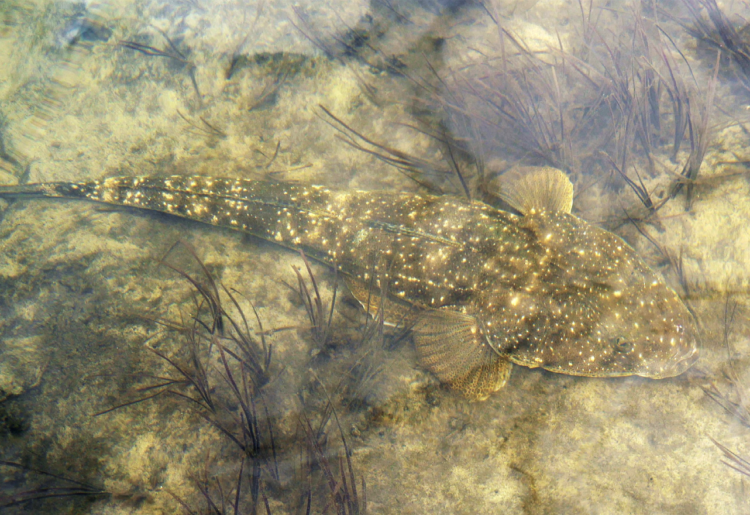
Another form of fishing that particularly benefits from reconnaissance is the pursuit of big flathead. These fish, whilst associated with aggregations of smaller males, are solitary in nature and can be widely spread over extensive areas of flats. Fortunately, they are creatures of habit, at least in the short term, so they should stay put until triggered to move. Given that we can’t all walk or drift an area the day prior, it certainly pays dividends to note the location of their lies, the flathead-shaped marks they leave in the sand, as well as any big girls that dart off as you get close. Occasionally, you’ll get up close to individuals that stay put. The pic hereabouts is of a 70cm dusky that followed my swimbait to my feet on a wading session, and stayed put whilst I got a pic … very strange!
In my experience, it is the hunt for big Murray cod at Copeton Dam that rammed home the importance of finding fish before fishing. After nearly 20 fishless sessions in which massive surface hits kept me coming back, I now catch cod on a regular basis, and I believe that tipping point was only fishing where the bait was schooled up. Now the first thing I do upon arrival, is to spend the first session looking for suitable locations that are holding plenty of bait. With a few bait-school and big cod waypoints stored on my Lowrance unit, I sneak back during low or no light periods, and cast my arms off!
Finding fish should be a priority for all anglers, whether it occurs prior to fishing or during fishing… unless you’d rather toss in a bait at your favourite spot and kick back. It’s purely a matter of preference!