

HOT summer days and warm nights bring forth myriads of flying bugs, beetles, and in our part of the world, Black Prince cicadas, all of which means there’s food in the sky for fish, and they become tuned for surface bites. For those that fish with a degree of stealth and patience, surface-feeding fish are nothing new, but rather an integral part of their fishing experience.
One of the tenants of angling success is to fish where the fish are. Obviously, fishing where there are no fish isn’t going to work, so we need to use the signs (apart from/or in addition to electronics), to maximise our success, and surface action (with or without birds), is one of the best long-range signs of feeding fish there is. By deliberately scanning the water’s surface you’ll see and hear all manner of interactions, and with practice be able to identify the predator from the sign. For instance, bream slurp creatures off the surface with a distinctive sound, barramundi “boof” their food, mangrove jacks explode on prey with a snap of their jaws and tuna and mackerel feed without noise other than that produced by spraying and splashing water. I suppose trout give themselves away somehow as well … maybe it’s a gentle sip generating expanding rings across the surface?
For me, summer means storing the snapper gear away until winter and hitting estuaries and rivers in search of whiting, flathead, mangrove jack, trevally, Murray cod and bass, and using surface lures on them all.
The surface-luring of whiting has been a craze for a few years now and for good reason. It is so much fun! When in the mood, whiting go crazy on smallish “walk the dog” style lures. At times, single fish attack from nowhere, but at others, they scream in to the lure in packs, like aquatic jet fighters, pushing and jostling to be the first to get to the “prey”. Cup-faced poppers are another option that works well, so it pays to switch things around until you find a lure that gets them biting.
The crossover lures that produce a small splash as they are worked across the surface are my favourite as you get the “walk the dog” action with the splashes of a popper. The trick with any lure is to keep it moving until you hook up.
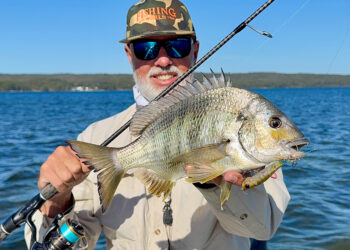
Bream are another species that take lure off the surface. Lures similar to whiting lures work on bream, although they prefer to hit a stationary offering. The go is to cast back into shade or against structure and let the lure sit for a while before gently tweaking it. If you don’t get a bite, retrieve for a while and let it sit again.
Alternatively, bream will nudge and even hit a moving lure, so as soon as you see they are bream, or if you hear the slurp of a bream, stop the retrieve and tease them until they take it.
Casting into timber for bream is a sure way to lose lures if you are fishing in a region holding mangrove jacks, although every year somebody manages to extract a horse of a jack on light line.
If nothing else, lost lures tell you where the jacks are! Larger surface lures on heavier line are the go with jacks, and by putting the lure back into tiger country and then ripping it out for a metre or so before pausing, can tempt a jack to leave cover in search of a meal … which is great news for us.
Trevally are well-known surface lure targets, be they the big bruisers found in the tropics or the smaller versions that crowd into estuaries. Enjoyment can be maximised by using tackle appropriate to the size of fish available e.g. there’s no point using 48kg line on 5kg jacks. In fact, 3kg line and a bream or whiting rod is a great way to enjoy the juvenile GTs and brassy trevally that spend time in estuaries.
Using a surface lure for flathead across the sandflats is a bone fide technique and one well worth trying. Large fish can be targeted with 15-20cm lures, whilst 10cm lures will lure in smaller models.
Flathead can move quickly over short distances, and they will zoom to a surface lure, but it’s the pause between movement that seems to get them excited. If they don’t hit a stationary lure, the first twitch is pretty good at getting a response.
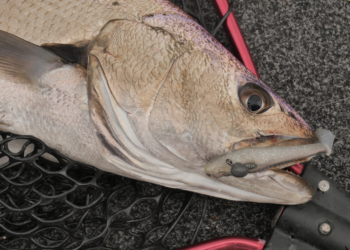
We can’t finish without including barramundi because I reckon there’s no more exciting a way to catch them than off the top. Be it a surface frog or unweighted fish-profile plastic, the bow wave of an incoming slab … heart-stopping stuff.