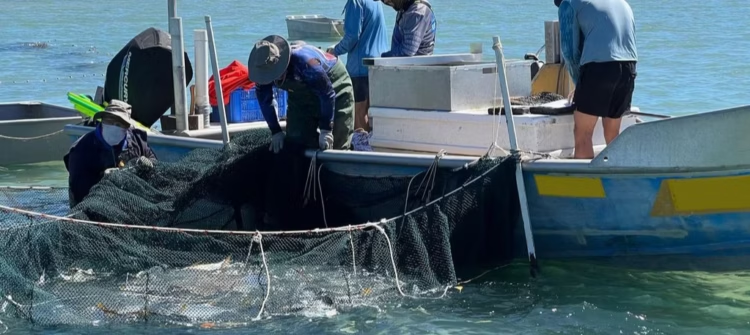
THE QLD Government is trialling tunnel nets as new commercial fishing gear on the beaches, bays and foreshores of the Great Barrier Reef World Heritage Area.
With wings spanning up to 1.6km, these are industrial-scale walls of mesh netting – over 130 buses parked bumper to bumper.
Imagine closing every lane of a major highway during peak-hour and funnelling all traffic into a single dead-end to be processed for market — that’s how tunnel nets operate for fish moving with the tide.
From our iconic sportfish – giant trevally, golden trevally and permit – through to bread and butter species, algae-sucking milkfish, and baitfish like the humble biddie. All can be removed, by the thousands, from shallow inshore waters, including fish nursery areas. And sold as cheap seafood, bait or petfood.
It’s our local fish populations, our marine life like dugongs and turtles, our coastal communities, and our regional economies that depend on tourism that will pay the price.
Watch out Bowen, Airlie Beach, Shute Harbour, Double Bay, other Whitsundays areas, Lucinda, Turkey Beach and Gladstone – tunnel nets have already been trialled in these waters.
But that’s just the start. Additional locations in Central & North Queensland are contemplated.
Trial sites have even included Dugong Protection Areas and Marine Parks, even though tunnel nets have been responsible for a Dugong death in South-East Queensland.
And the inshore coastal flats where tunnel nets are used are typically mangrove fringed fish nursery habitat, making juvenile fish especially vulnerable.
Tunnel nets can catch over 6000 fish, weighing over 2 tonnes, in a single deployment. In just 17 trial shots, they indiscriminately caught over 30,000 fish, spread across 50 + different species.
97% by weight of the trial catch was lower seafood value “by-product” or “by-catch”. Only 3% was the northern “target” species – Barramundi and King Threadfin.
Baitfish that attract predators like Queenfish, Mackerel and Tuna inshore, comprised over 15% of the trial catch.
And most of the fish caught during the trials are not protected by stock assessments, commercial quotas or commercial size limits. Juveniles can be taken.
Local economies are underpinned by tourism. Local businesses depend on recreational anglers who inject over $1.48 billion annually into regional QLD economies.
Abundant fish stocks and the “world-class” fishery reputation are a driver of destination choice.
It’s the local charter operators, tackle stores, motels, pubs, cafes, restaurants, transport providers and more, who will pay the price of reduced or depleted fish stocks.
And the local families who just want to catch a fish off the shore, or take their boat for a spin.
What can you do?
Sign this petition. Share it with your mates.
Right after you’ve signed this petition:
- Head to the website www.inshoreflatsproject.com.au for more info and sign up to the newsletter
- Follow on social media @theinshoreflatsproject