
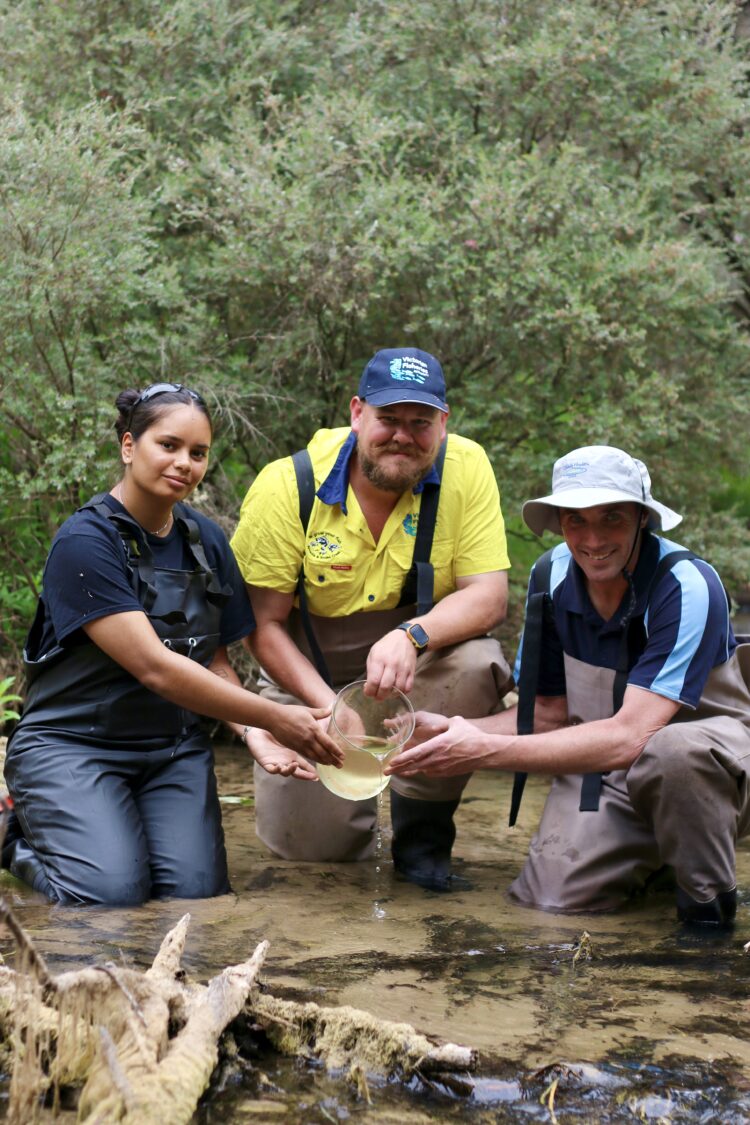
OFFSPRING from an Australian-first Glenelg freshwater mussel conservation program have been released into the Crawford River in southwest Victoria in a world-first restocking of the species.
The stocking is the first ever undertaken for the critically endangered species, which has one remaining wild population, and is a significant milestone in a recovery project led by Glenelg Hopkins CMA, Victorian Fisheries Authority (VFA), the Arthur Rylah Institute and Gunditj Mirring Traditional Owners Aboriginal Corporation.
The Building (Glenelg Freshwater) Mussels project is a $490,000 initiative by the Australian Government’s Saving Native Species Program, delivering on-ground works around habitat, waterways and a captive breeding program at the VFA’s Snobs Creek Conservation Hatchery to reverse the decline of the species.
The release today of juvenile captive-bred mussels and adult mussels collected as part of the project from the Crawford River last year, was undertaken by Budj Bim Rangers from the Winda-Mara Aboriginal Corporation, VFA and Glenelg Hopkins CMA.
Glenelg Hopkins CMA CEO Adam Bester said it is really exciting to get to a point where mussels have been found and taken into the hatchery, successfully bred, with offspring returning to their native waterways where we have undertaken revegetation, fencing and sediment control works to ensure a healthy environment for them to thrive in.
VFA CEO Travis Dowling said our Snobs Creek Conservation Hatchery was the first to breed these precious mussels last year, so it’s exciting to see the offspring from those efforts boosting numbers in the wild.
“By 2035 we aim to have seeded three new self-sustaining populations of these mussels in different parts of the system, to boost their genetic diversity and protect the species from the ongoing threat of bushfires, floods, siltation events, and introduced carp,” Dowling said.
Glenelg freshwater mussels live for up to 10 years, including an early-life stage spent as a parasite living on the fins and gills of small-bodied native fish, enabling their movement through the river system.
They are only found in the sandy riverbeds of south-west Victoria. As filter feeders, their greatest threat to survival is sedimentation of those waterways through river-bank erosion, and fire ash deposits.
The Glenelg freshwater mussel is a part of the VFA’s 10inTen plan to stock and recover ten threatened aquatic species in as many years, in partnership with the Department of Energy, Environment and Climate Action’s Arthur Rylah Institute for Environmental Research.
More info at www.ghcma.vic.gov.au.